
news

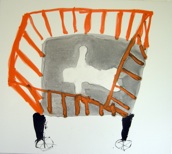
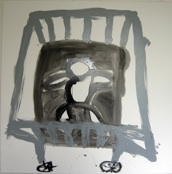
Mixed media on canvas 105 x 110 cm & 105 x 105 cm from series Bettlein 2011
from series Vocal Chords 2011 oil bar,enamel, graphite on canvas
1m x 1m
Fugitive Dream of Paradise by Fritz Muggler on Jeanine Osborne’s ‘Walls of Paradise’.
Valparaiso has not only been a historically important port city on the South American pacific coast of Chile, but also in the Spanish-speaking land of origin there is a valley of paradise with the Fundacion Valparaiso, to which this poetic-musical composition by the singer, poet, instant compopser, painter and photographer Jeanine Osborne is dedicated. Her stay in Valparaisoo permitted the word play between “val” and “wall”. Such play with words and sounds are typical in a text, filled with fantasy and wide associations, linguistic as well as cognitive, often of the wildest nature, with contrasts and the most opposing ideas, not only between words or short units of text, but often within them, from word to word, or phrase to phrase. As when dreaming, things and events disengage abruptly, but, even more frequently, flow and glide into one another
In text and music, that which appears to be momentarily improvised from instance to instance, is not at all the case. The distribution between spoken and sung text is precisely thought out, also the entries for the music, mostly a richly played cello (Matthias Schranz) and sometimes with guitar (Seth Josel) are clearly and competently placed. Very often, the instrumental music paves the way for the voice which develops freely out of the moment, imparting special immediacy, then later integrates itself resonantly and organically. The music moves stylistically with free reminiscence of classical idioms, without shunning quotations from known works and again evoking impressions of free improvisation and association.
Despite changes in theme and subject, it is clear that the piece talks of an angel (or an outcast that represents a well-known theological topos?) and walls inside Paradise, though one does not know if Paradise is as pardisean as often believed. This Paradise is placed, time wise, between Euphrates and Tigris, the altar on which Isaac was supposed to be sacrificed is mentioned, (And why not Ishmael? Was God vegetarian and did he ever since, become bulimic? These small outbursts are stimulating as well as cheering) and also the current political issues are touched upon. And there is a part, somehow remininiscent of James Ensor, that works very apocalyptically, leading on to the colonization of Paradise, in which one can buy the usual souvenirs only until the tourists have swept the place clean!
The angel is always “she”. The subsequent counting of her body parts suggests “the Song of Songs”. The “Seven Days of Creation”, full of grotesque details, leads to a liturgically complete, though dislocated and disturbing requiem, from “Gloria” to “Donna Eis Requiem” and finally to a “new version” of Paradise. The lullaby that follows, is so beautifully and wonderfully sung, that in principle, it might be enough to conquer the hit parade. Ater beginning as a reading with musical interludes, the work develops at the end to a great and compact musical climax in which quotation of Purcell’s “remember me” is included as if by chance (yet again magnificently sung) and a larger quotation of Johann Sebastian Bach’s “Art thou by me I go gladly to my death”, though ironically broken and questioned to the smallest detail, dissolves in order to lead in a kind of apotheosis, to total oblivion, a kind of white blackout at the end. Whereas at the start, it is the lyrical qualities, characterized moreover by a strictly modern, post expressionist style, which captivates, in the large final section, it is the music which convincingly develops in large ascending bows, unbroken towards conclusion.
The performer Jeanine Osborne is a singer of the highest professional quality, with a wonderful trained voice, with which she can do everything, a voice, which also when improvising, can form any musical idea convincingly; the cooperation with the instruments as well is accomplished to perfection, even though one could imagine from time to time a transgression towards more current sound properties, for instance, towards microtonality or estrangement of sound to accord with the expressiveness of the text, which in its dissolution of the spoken syntax has a highly modern impact. The music was conceived by the American composer John Anthony Lenon.
The work can be produced on stage in a pure accoustic form, or shown with video, displaying in conjunction photographs of austere landscapes in which an angel, in a white loose shirt with winglike wide sleeves, interacts in tree branches, in ruins, in mines, partly also in moving images, without being coordinated or illustrative, also here, entrusted all the more to “coincidence”, to association, to the unconfined inner coherence. The pictures, whether photographed or drawn with powerful contours, primal by nature, are all produced by Jeanine Osborne and she herself portrays the angel in the photos and in film sequences. Even when some aspects remain enigmatic, the entirety is shaped by authenticity and uniformity. The work lasts over an hour.
Fritz Muggler,
music critic.
Sogar Theatre, Zürich,
3 Sept 2011 Music Performance: “und haben zu Leben und Sterben kein Mittel genommen.” Jeanine Osborne - voice, &
Martin Kunz - piano.
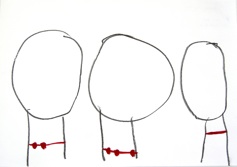
From Vocal Chords, graphite & enamel on paper 42 x 59 cm, 2011.